

CompTIA Certification Career Path Guide (2026)
Feb 5th 2026
CompTIA Certification Career Path Guide
Choosing the right IT certification path can feel overwhelming — especially with technology evolving faster than ever. Whether you’re starting your tech career, pivoting from another industry, or advancing into cybersecurity, cloud, or AI, CompTIA certifications provide a structured roadmap recognized worldwide.
This CompTIA Certification Career Path Guide breaks down each stage of the journey, helping you understand which certifications to pursue, what skills they validate, and how they align with real-world IT roles.
Why CompTIA Certifications Matter
CompTIA is one of the most respected names in IT certification, trusted by employers globally. Unlike vendor-specific credentials, CompTIA certifications are:
-
Vendor-neutral
-
Role-based
-
Aligned with real job skills
-
Recognized by government and enterprise employers
From help desk to cybersecurity architect, CompTIA offers stackable certifications that grow with your career.
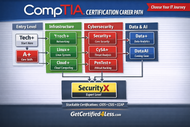
CompTIA Career Path Overview
CompTIA certifications are organized into clear career tracks:
-
Core IT
-
Infrastructure
-
Cybersecurity
-
Data & AI
-
Cloud & Networking
-
Professional & Expert-level certifications
Each level builds upon the previous one, allowing professionals to advance strategically rather than randomly collecting credentials.
Entry-Level IT Career Path
CompTIA Tech+
Best for: Beginners with little or no technical experience
Tech+Certificaiton introduces basic computing concepts, software, security, and infrastructure fundamentals. It’s ideal for:
-
Students
-
Career changers
-
Non-technical professionals entering IT
CompTIA A+
Best for: Help desk and technical support roles
CompTIA A+ is widely considered the starting point for IT careers. It validates skills in:
-
Hardware and peripherals
-
Operating systems
-
Mobile devices
-
Networking basics
-
Security fundamentals
-
Troubleshooting methodology
Common job roles:
-
Help Desk Technician
-
IT Support Specialist
-
Desktop Support Technician
Infrastructure Career Path
Once foundational skills are established, professionals often move into infrastructure and operations roles.
CompTIA Network+
Focus: Networking concepts and troubleshooting
Network+ covers:
-
Network architecture
-
TCP/IP and protocols
-
Routing and switching
-
Wireless technologies
-
Network security
-
Performance optimization
Career opportunities include:
-
Network Technician
-
Junior Network Administrator
-
IT Infrastructure Specialist
CompTIA Server+
Focus: Server administration
Server+ validates hands-on skills related to:
-
Physical and virtual servers
-
Storage technologies
-
High availability
-
Disaster recovery
-
Data center operations
Ideal for professionals supporting on-prem or hybrid environments.
CompTIA Linux+
Focus: Linux system administration
Linux+ is critical for modern IT environments that rely on open-source systems. It covers:
-
Command-line management
-
Linux security
-
Scripting and automation
-
System configuration
-
Troubleshooting
CompTIA Cloud+
Focus: Cloud infrastructure operations
Cloud+ validates real-world skills for managing cloud environments, including:
-
Hybrid and multi-cloud deployment
-
Cloud security controls
-
Resource optimization
-
Virtual networking
-
Troubleshooting cloud services
Cybersecurity Career Path
Cybersecurity continues to be one of the fastest-growing IT sectors worldwide.
CompTIA Security+
The industry-standard cybersecurity certification
Security+ validates baseline cybersecurity knowledge such as:
-
Threats, attacks, and vulnerabilities
-
Risk management
-
Network security
-
Identity and access management
-
Incident response
Common roles:
-
Security Analyst
-
SOC Analyst
-
Cybersecurity Administrator
CompTIA CySA+
Focus: Defensive cybersecurity and threat detection
CySA+ emphasizes:
-
Security monitoring
-
Log analysis
-
Behavioral analytics
-
Incident response workflows
-
Threat hunting
CompTIA PenTest+
Focus: Ethical hacking and penetration testing
PenTest+ covers:
-
Vulnerability scanning
-
Exploit techniques
-
Penetration testing methodology
-
Reporting and remediation
CompTIA SecurityX (formerly CASP+)
Expert-level cybersecurity certification
SecurityX is designed for advanced professionals responsible for:
-
Enterprise security architecture
-
Risk governance
-
Advanced threat management
-
Cloud and hybrid security strategy
Data & Artificial Intelligence Career Path
As AI reshapes business operations, CompTIA now offers certifications aligned with modern data and automation roles.
CompTIA Data+
Focus: Data analytics fundamentals
Data+ validates skills in:
-
Data mining
-
Visualization
-
Statistics
-
Data governance
-
Business reporting
CompTIA DataAI
Expert-level data and AI certification
CompTIA DataAI is designed for experienced professionals working at the intersection of:
-
Data science
-
Machine learning
-
AI operations
-
Governance and ethics
-
Enterprise analytics
Stackable CompTIA Certifications
One of CompTIA’s biggest advantages is its stackable certification program, which combines multiple certifications into recognized career credentials.
Examples include:
-
IT Operations Specialist (CIOS)
A+ + Network+ -
Systems Support Specialist (CSSS)
A+ + Linux+ -
Cloud Admin Professional (CCAP)
Network+ + Cloud+ -
Secure Infrastructure Specialist (CSIS)
Network+ + Security+
Stackable certifications help employers quickly identify validated skill sets.
Which CompTIA Path Is Right for You?
| Career Goal | Recommended Certifications |
|---|---|
| IT Support | Tech+, A+ |
| Networking | A+, Network+ |
| Systems Admin | Network+, Server+, Linux+ |
| Cloud Engineer | Network+, Cloud+ |
| Cybersecurity | Security+, CySA+, PenTest+, SecurityX |
| Data & AI | Data+, DataAI |
| IT Leadership | SecurityX, Cloud+, DataAI |
Why Buy CompTIA Vouchers from GetCertified4Less
GetCertified4Less is a CompTIA Platinum Partner and authorized Pearson VUE test center, offering:
-
Discounted CompTIA exam vouchers
-
Retake Assurance options
-
Fast digital delivery
-
Official CompTIA products
-
Secure checkout
Whether you’re pursuing your first A+ exam or advancing toward SecurityX or DataAI, we help make certification more affordable.
Start Your CompTIA Career Path Today
CompTIA certifications provide more than credentials — they offer a clear roadmap for long-term career growth in IT, cybersecurity, cloud, and artificial intelligence.
By following a structured certification pathway, you can:
-
Build skills progressively
-
Increase earning potential
-
Qualify for in-demand roles
-
Stay competitive as technology evolves
Explore discounted CompTIA certification vouchers at GetCertified4Less and take the next step in your IT career today.
Frequently Asked Questions — CompTIA Certification Career Path
1) What is the best order to take CompTIA certifications?
For most people, the recommended order is:
Tech+ (optional) → A+ → Network+ → then specialize.
After Network+, you typically choose one of three lanes:
-
Cybersecurity: Security+ → CySA+ or PenTest+ → SecurityX
-
Cloud/Infrastructure: Cloud+ (often with Linux+)
-
Data & AI: Data+ → DataAI
This keeps your learning logical and reduces knowledge gaps.
2) Do I need Tech+ before A+?
No. Tech+ is optional.
Choose Tech+ if:
-
You are brand new to technology
-
You’ve never built a PC, used troubleshooting, or worked with basic networking
Skip Tech+ if:
-
You already have basic computer experience
-
You’ve worked in help desk, retail tech support, or similar roles
Most career changers go straight to A+.
3) Should I take Network+ before Security+?
In most cases, yes.
Network+ helps you understand:
-
How data moves across networks
-
Ports and protocols
-
Common traffic patterns
-
How attacks actually travel
That foundation makes Security+ significantly easier.
You can start with Security+ first only if you already work around security tools or have strong networking experience.
4) What jobs does CompTIA A+ prepare you for?
A+ aligns with common entry-level IT roles such as:
-
Help Desk Technician
-
Desktop Support Specialist
-
IT Support Technician
-
Technical Support Specialist
-
Junior IT Administrator
It is widely accepted as the standard “first IT certification.”
5) What is the fastest path into cybersecurity?
A practical cybersecurity pathway is:
Option A (best for most beginners):
A+ → Network+ → Security+ → CySA+ (defensive) or PenTest+ (offensive)
Option B (if you already work in IT):
Network+ → Security+ → CySA+ or PenTest+
Advanced level:
SecurityX (for leadership, architecture, and enterprise security roles)
6) What CompTIA certifications are best for cloud roles?
The strongest starting path is:
Network+ → Cloud+
Many cloud professionals also add:
Linux+, because Linux powers most cloud environments.
This combination prepares you for roles such as:
-
Cloud Administrator
-
Cloud Operations Engineer
-
Cloud Support Specialist
7) What is a CompTIA stackable certification?
Stackables are bonus credentials you earn automatically when you complete specific combinations of exams. Examples include:
-
CIOS (IT Operations Specialist): A+ + Network+
-
CSSS (Systems Support Specialist): A+ + Linux+
-
CCAP (Cloud Admin Professional): Network+ + Cloud+
-
CSIS (Secure Infrastructure Specialist): Network+ + Security+
These help employers quickly recognize your combined skill set.
8) How long does it take to complete A+, Network+, and Security+?
On average:
-
A+ → 6–12 weeks
-
Network+ → 6–10 weeks
-
Security+ → 6–10 weeks
Your timeline depends on:
-
Prior experience
-
Weekly study hours
-
Hands-on practice
-
Access to labs or simulators
9) Can I skip A+ and start with Network+?
Yes — if you already:
-
Work in IT
-
Understand basic hardware
-
Are comfortable troubleshooting PCs
-
Have some networking exposure
If not, A+ is still highly recommended.
10) Which CompTIA path makes the most money?
Generally (on average in the U.S.):
-
Cybersecurity (Security+, CySA+, PenTest+, SecurityX)
-
Cloud (Network+, Cloud+, Linux+)
-
Systems/Infrastructure (Server+, Linux+)
-
Entry-level IT (A+)
Salaries vary by region, experience, and industry.